
Does Graphene Coating Actually Work?
A Nobel Prize–winning material ended up in a $40 spray bottle. Here's what it actually is, why it's paired with SiO₂, and how to tell — on your own paint — whether it's doing the work.

Sunlight is breaking your clear coat. Not metaphorically — actually breaking it.
UV photons in the wavelengths that reach your paint carry enough energy to snap the long molecular chains in the polymer that's protecting it. Oxygen in the air finishes what the photon starts. Multiply that by every minute your car sits in the sun, across years, and the surface roughens, microscopically, until it stops reflecting light cleanly and starts scattering it. That's why old paint looks dull.
This is settled chemistry. It's also why every credible paint-protection product (wax, sealant, ceramic, graphene) does the same fundamental job: slow that clock down. The honest question for any new product isn't does it work? It's how much does it slow the clock?
For a graphene coating, the answer starts with what graphene actually is.
What graphene actually is
Graphene is a single layer of carbon atoms arranged in a hexagonal pattern. Picture chicken wire, but the wire is one atom thick. That's the entire material.
It sounds underwhelming until you look at the numbers.
At the atomic plane, graphene has been measured at roughly 200× the tensile strength of steel — the strongest material ever recorded. A spray coating doesn't deliver that number on your hood (no graphene-composite product does), but even a small fraction of that strength, dispersed inside a silica matrix, is what gives a graphene-ceramic its toughness advantage over plain SiO₂.
It's also the thinnest stable material known. You could stack roughly 300,000 sheets of it before you matched the thickness of a single sheet of office paper. Three million sheets get you the thickness of a credit card.
That's not marketing. That's textbook material science.
A Nobel Prize winning material: Andre Geim and Konstantin Novoselov won the 2010 Physics prize for isolating it. The award was for the underlying physics, not for any product. Public record. Verifiable in a 30-second search.
We didn't invent graphene. We use it. The interesting question is what we pair it with.
Why graphene needs a partner: the rebar idea
Graphene by itself isn't a coating. It's a flat sheet of carbon. To bond to your paint and protect it, it needs a host material that hardens around it.
That host is SiO₂, silicon dioxide. The same chemistry behind every “ceramic” coating on the market. SiO₂ on its own is hard, glassy, and bonds well to clear coat. It's been the workhorse of paint protection for a decade.
Hard, though, isn't the same as tough. A pane of glass is hard. It also shatters when something flexes it.
The mental model is rebar in concrete. Concrete handles compression — being pushed on. Steel rebar handles tension — being pulled apart. Neither is impressive on its own. Together they hold up bridges.
SiO₂ is the concrete: hard, rigid, good at resisting being pressed into. Graphene is the rebar: extraordinarily strong in tension, with the unusual ability (because it's a 2D sheet) to stop a microscopic crack from spreading. When a tiny fracture starts somewhere in the coating layer (from a stone chip, a stiff brush, thermal expansion in summer heat), a graphene flake in its path forces the crack to detour. Cracks that detour use up energy. They run shorter. Many of them stop entirely.
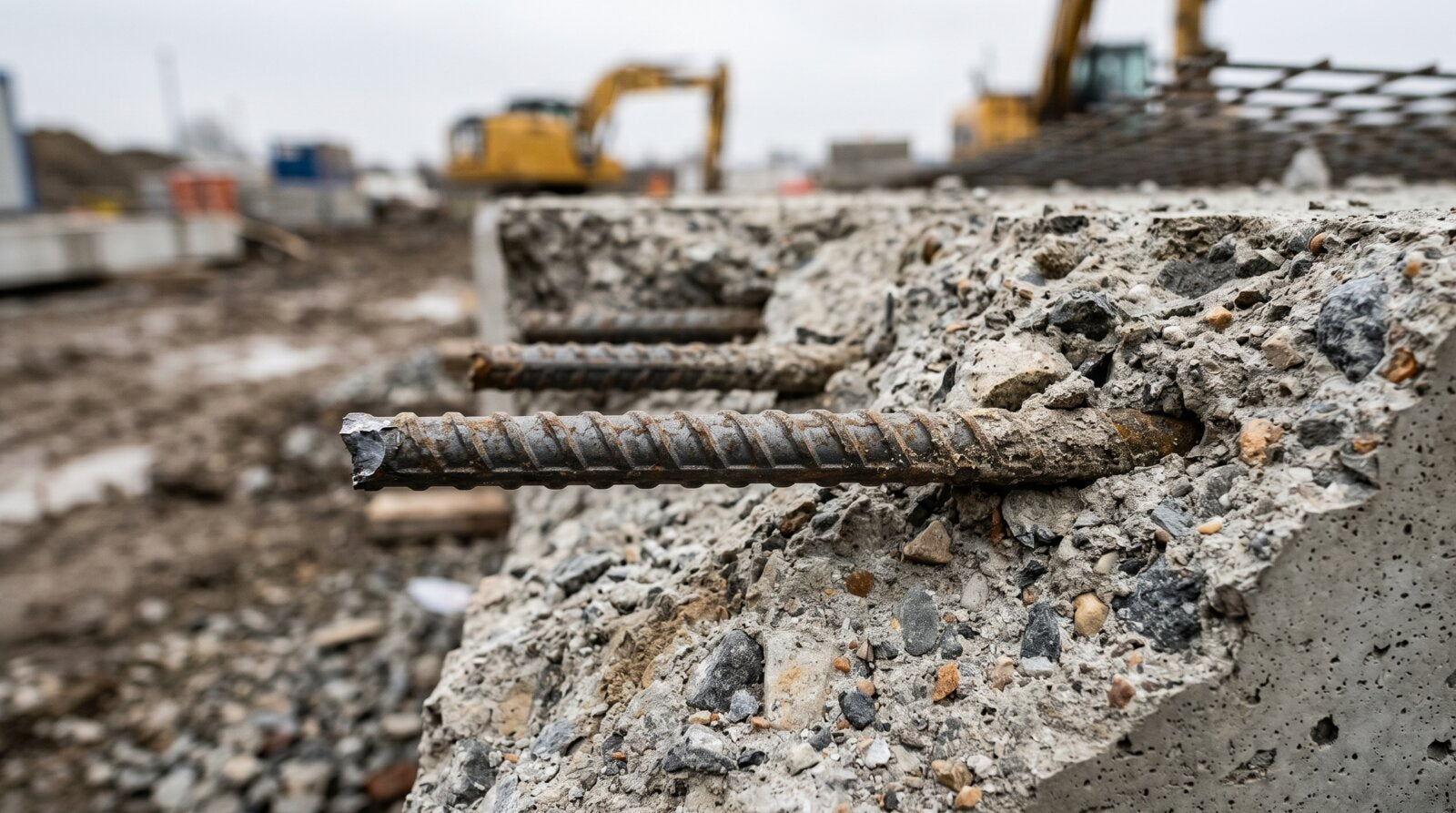
Published work on graphene-reinforced silica composites consistently reports meaningful fracture-toughness gains over plain silica — the range depends on how well the graphene is dispersed, but the direction is the same in every study: the composite cracks less and slower than the silica alone. That's the rebar working.
This is why “graphene + SiO₂” isn't a marketing combo — it's the chemistry. SiO₂ for hardness. Graphene for toughness. Together, a coating that resists both being scratched and being cracked.
What it does on your paint
Knowing the material is strong on paper isn't the same as knowing it does anything for your car. So here's what actually happens.
When you spray a graphene + SiO₂ coating onto clear coat and spread it with a microfiber, two things happen at the molecular level.
First, the coating bonds to the clear coat. Not a wax sitting on top, waiting to wash off the next time you go through a touchless. A bonded layer that becomes part of the paint surface for as long as the coating lasts.
IMAGE: technical cross-section diagram of the coating stack (Coy-generated, Gemini; revision-note labels patched 2026-06-09)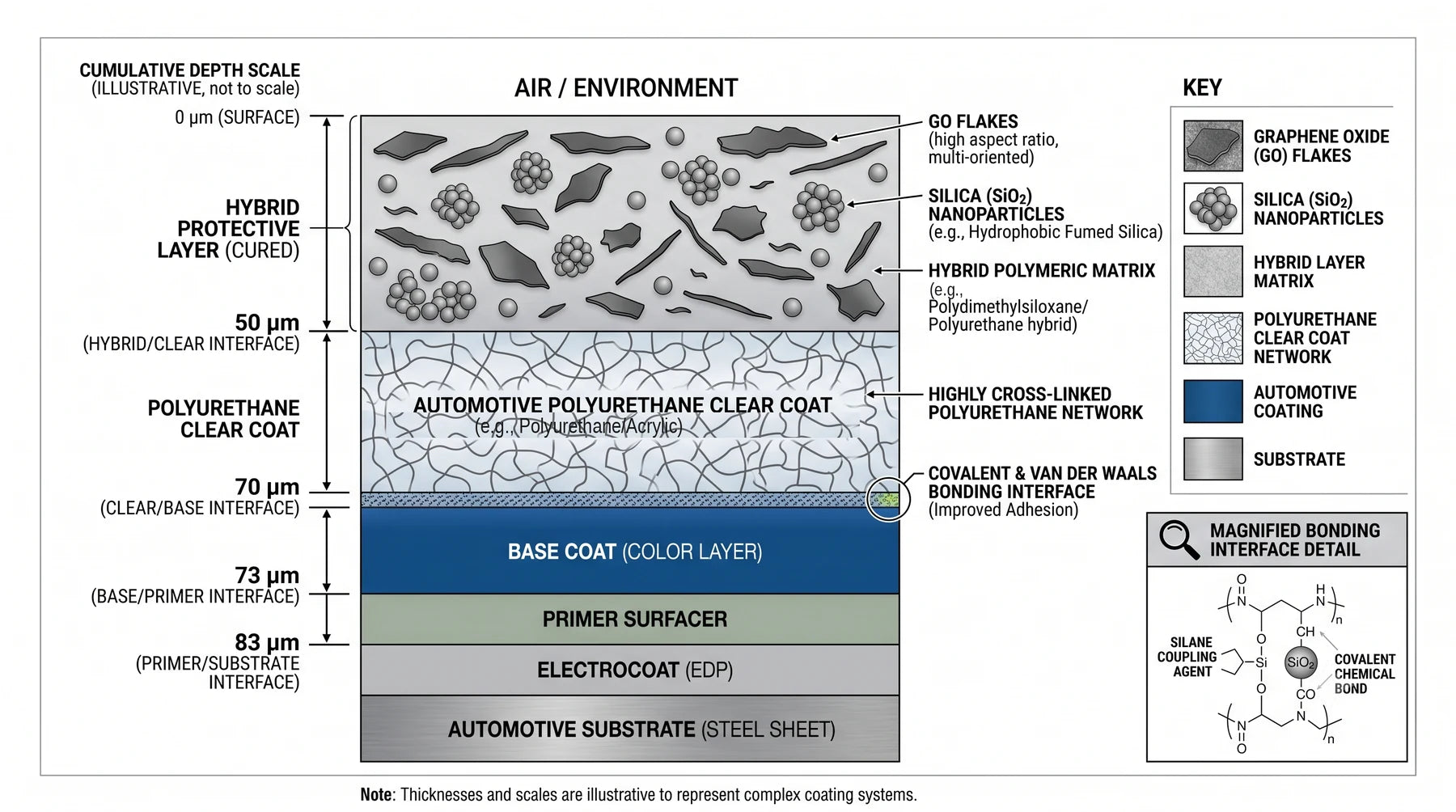
Second, that bonded layer changes the surface itself. The surface gets dramatically smoother and more hydrophobic (water-repelling). Water that lands on it forms tight beads and rolls off instead of clinging. UV photons get reflected and dispersed across the layer instead of reaching deeper into the clear coat to break those polymer chains. Bird droppings, tree sap, light iron fallout — all of which are mildly acidic and corrosive — sit on top of the coating instead of etching through to the paint underneath.
Accelerated-weathering studies (the ones that simulate years of sun exposure in a sealed UV chamber, on standardized panels) consistently show coated panels retaining substantially more gloss than uncoated panels over the same cycle. That's not a ShineMD claim — it's the established body of work on ceramic and graphene-ceramic surface chemistry, going back over a decade.
There's also a quieter mechanism that matters more than people realize: contact time. Damage to clear coat scales with how long contaminants sit on the paint. Think of a coffee spill on a counter: wipe it up immediately, no stain. Leave it for an hour, you've got a ring. Same idea with sap, water spots, iron particles. On a hydrophilic (water-loving) surface, water and contaminants spread out and cling. On a hydrophobic graphene-coated surface, they bead up and slide off — sometimes before they ever fully dry.
Two examples of what that buys you in real life.
Hard water on a hydrophilic surface dries in a flat puddle, leaving a halo of calcium and silica minerals that bond to the clear coat — water spots that take chemical removers to clear. On a coated surface, the same water sheets off before it dries. No halo.
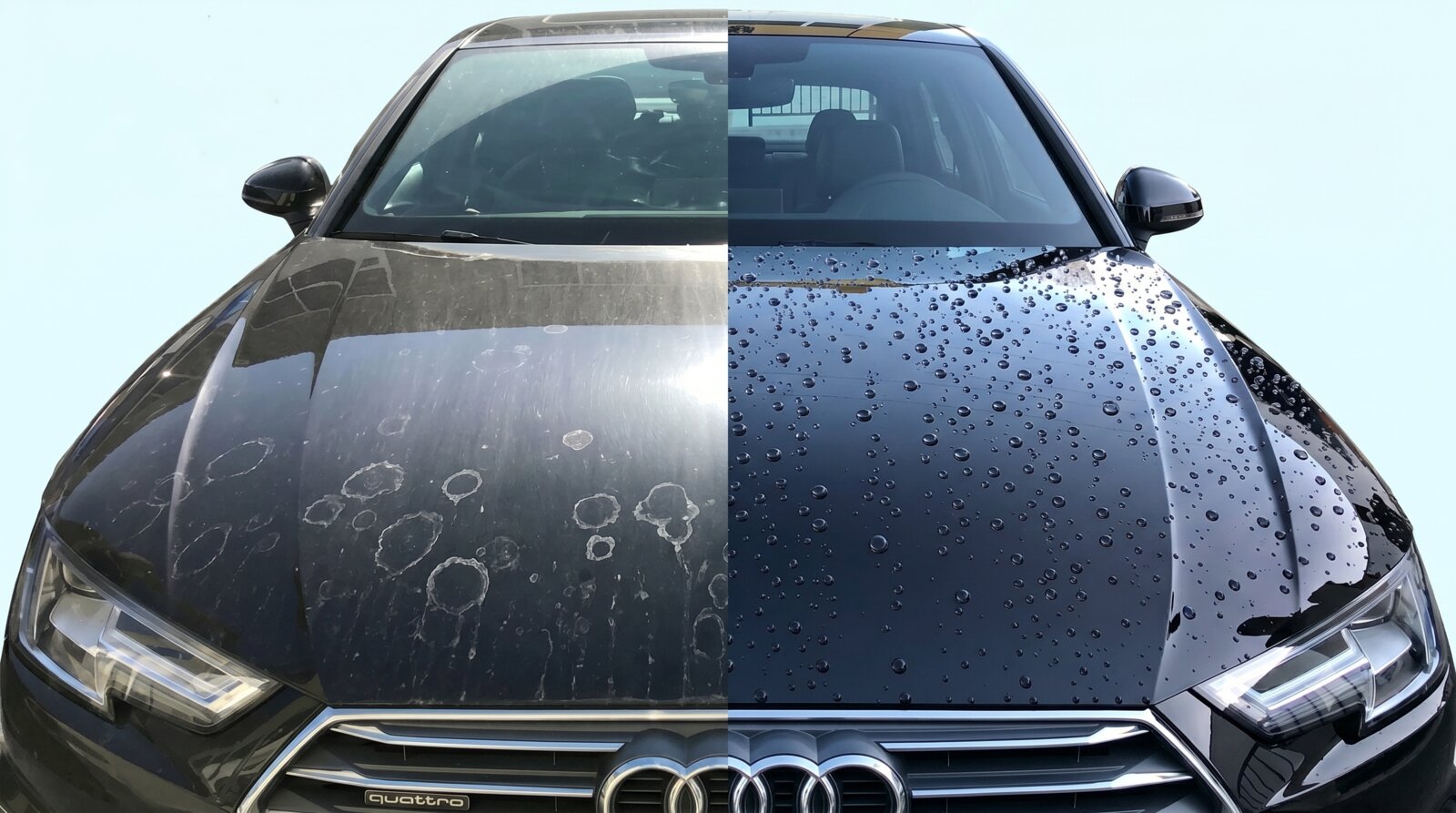
Iron particles from brake dust or rail dust on a hydrophilic surface sit in damp pockets, where iron + moisture + oxygen run a slow oxidation reaction at the surface — iron particles act as a catalyst, accelerating the breakdown of nearby clear-coat chemistry. It's the same mechanism behind the rust-colored stains that appear on light paint after weeks of being parked near train tracks or industrial sites. On a hydrophobic coated surface, those particles wash away in the first rinse, before they can settle in.
And then the everyday payoff: when you wash, the contaminants that would normally drag dirt across your clear coat — and grind in micro-swirls — instead glide across the slicker surface. That ease is the single most-cited owner observation across our review base. The wash is the same job. The car is just easier to wash.
The proof you can verify yourself
Science and specs only go so far. At some point, you want to see it on your car.
Three things will tell you the coating is doing what it's supposed to do.
Water beading. First wash after application — water hits the panel and forms tight, high-contact-angle beads that roll right off. That's the coating working. If the beading still looks like that at month six, the coating is still working at month six.
IMAGE: real photo — tight beading on the black hood at the wash bay (source: _incoming/CARSON/hana-photos/hana-water-beading.jpg, phone still)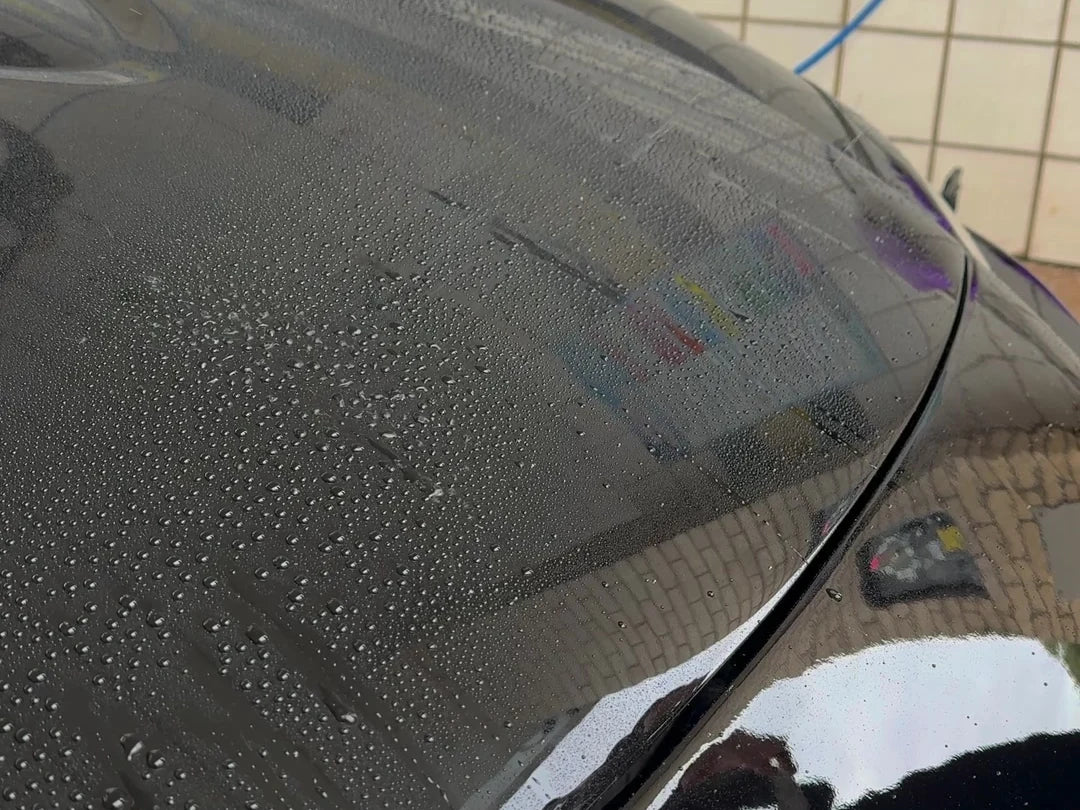
The fingertip test. Drag your fingertips across a panel after application. The surface feels profoundly smoother — almost slippery. That's the friction reduction at the molecular level. You can feel it before you can measure it.
The bottle slide. Set a full bottle on a flat coated panel and let go. It slides off like an air-hockey puck. This isn't a only-graphene-does-this test (well-waxed paint will let a bottle slide too), but the distance and the speed are noticeably different on a freshly coated panel, and the demo is a satisfying first-week proof that the coating took.
None of these are lab tests. They're things you can do on your own paint, the first weekend after you apply. The coating either does these things or it doesn't — and it does.
“But is it hard to apply?”
The most common reason people put off trying a graphene coating isn't skepticism about the science. It's worry about the application.
Reasonable. Pro-shop ceramic kits have a real failure mode — high spots that flash past their working window before you can buff them, streaks that harden into the film, missed panels that need the whole coating polished back before they can be touched up. The fixes exist; they're just expensive in time and tools. Hours of careful work and days of cure time, with a real “did I do this right?” gut-check at every step.
A graphene spray works differently. The whole job is one walk-around the car. Spray, spread, move on. If you streak it, you spread it again. If you miss a spot, you re-spray. There is no install mistake that locks in before you can fix it.
That ease-of-use is the entire reason the spray-on graphene category exists — protection has to be cheap enough in time and skill that real owners will actually apply it.
How long it lasts (the honest answer)
The honest answer is 6–12 months, depending on climate and wash frequency. Not 12. Not 6. The range, with the caveat.
A garage-kept weekend car in a mild climate, hand-washed, will trend toward the top of that range. A daily driver in harsh sun and harsh winters, run through automated washes, will trend toward the bottom. The realistic middle for most owners is 8–10 months.
The proof that it's still working isn't a calendar reminder. It's the beading. As long as water still pearls off the panel, the coating is still on the paint. When the beading flattens, it's time to refresh.
You'll know.
Try ShineMD on your car.
Graphene + SiO₂ formula, developed and tested in the USA.
60-day money-back guarantee.
Fast shipping · No subscription required · Easy returns
- Fast Shipping
- 60-Day Moneyback
- Formulated in USA
- 900+ Reviews
- Graphene Featured In NYT · Forbes · WaPo