
7 Reasons Enthusiasts Are Switching From Wax
Wax has been the gold standard for fifty years. So why are the people most obsessive about their paint — show car owners, weekend detailers, garage perfectionists — quietly putting it down? Seven reasons, in plain language.

Wax isn't bad. It just isn't winning anymore.
For most of the last fifty years, a coat of carnauba on a Saturday afternoon was the gold standard for paint protection. The smell. The slow buff. The deep, wet shine on Sunday morning. There's a reason this ritual stuck around: it works, it's earned, and the result is genuinely beautiful.
Then graphene-led ceramic coatings showed up — the same chemistry that built the pro-detail world over the last decade, distilled into a $40 spray bottle. And the people who were most obsessive about wax started switching. Not the casual once-a-summer crowd. The owners who care about every panel.
What changed? The science. Here are seven reasons the most demanding paint owners are making the move.
1. It bonds to the paint instead of sitting on top
Wax is, chemically, a soft layer that sits on your clear coat. It's held there by weak surface attractions — the kind of grip a gecko uses to walk on glass, scaled down. It works fine, until something stronger pulls it off.
A graphene + SiO₂ coating is different in kind. The silica network forms covalent bonds with itself and chemical attachments to the clear-coat surface, and the graphene sheets get locked into that bonded layer. It becomes part of the surface for as long as the coating lasts.
Translation: a fingerprint can pick up wax. Soap can carry it away. Heat can soften it. None of that touches a graphene-bonded layer the same way. The coating stays put because it's chemically attached, not just resting there.
2. It survives summer heat
Carnauba wax has a melting point right around 180°F. That sounds high until you measure your hood on a 90°F day in direct sun — black paint can climb past 160°F, and dark hoods past 180°F. Wax under those conditions doesn't vanish, but it softens. It thins. It moves. The protection you laid down in May is doing less work in August.
Graphene + SiO₂ doesn't soften in summer heat. The bonded silica matrix is stable to temperatures well beyond anything paint will ever see in normal driving. The protection you put on in May is the same protection you have in August.
3. It survives the wash
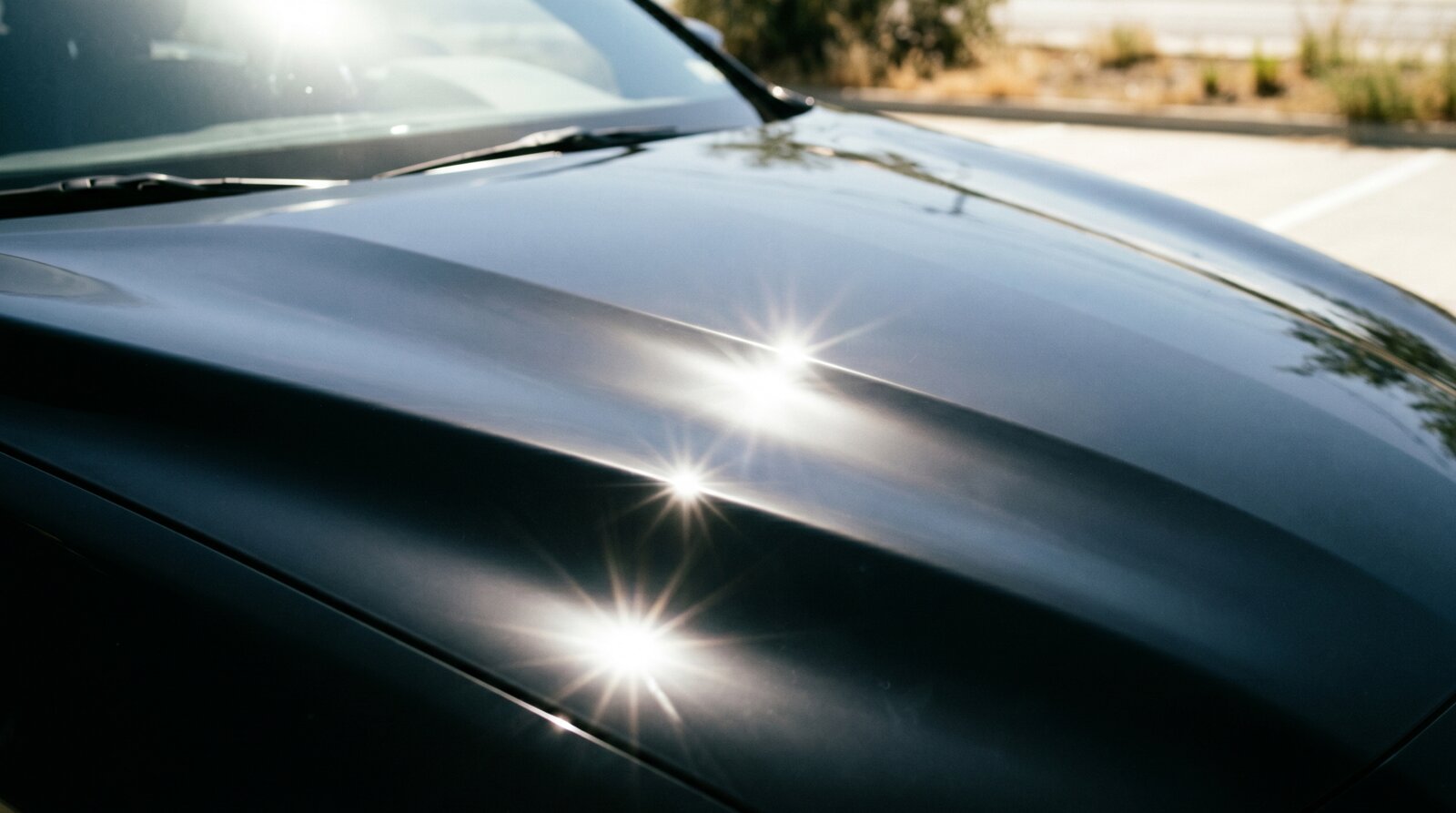
Wax is soft and non-polar. Soap, even pH-neutral car shampoo, is designed to lift non-polar things off surfaces — that's literally what surfactants do. Every wash takes some wax with it. Add the iron removers, snow foams, and bug-and-tar sprays most owners use a few times a year, and the loss accelerates. Three or four real washes in, the protection is materially thinner.
A bonded ceramic-graphene layer is chemically inert to the soaps people actually use on cars. You can wash a graphene-coated car with whatever you have — the coating doesn't care. It's still there at wash 1. It's still there at wash 30.
That's why durability for a graphene coating is measured in months and durability for wax is measured in washes.
4. It lasts 6–12 months instead of weeks
On a quality carnauba, 8–12 weeks of useful protection is the high end: a garage-kept car, hand-washed, mild climate. A daily driver in summer sun runs that clock down to 4–6 weeks.
A graphene coating gives you 6–12 months of protection, depending on climate and wash frequency. Same variables, roughly four to six times the window. The realistic middle for most owners is 8–10 months on a single application.
If you're someone who waxes four or six times a year, a graphene application is one Saturday that replaces all of them.
5. It changes how dirt behaves on the surface
This is the one most enthusiasts don't see coming. Wax makes paint feel slick — that's familiar. A graphene coating changes how contaminants interact with the surface, which is a different category of effect.
On a coated panel, water beads up and rolls off instead of spreading and clinging. That sheeting effect carries a lot of stuff with it. Pollen rinses off in the first pass. Bird droppings sit on the coating instead of etching directly into the clear coat — you typically have hours to wipe them off, not minutes. (Heat and direct sun shorten that window. Wipe sooner than later.) Hard water dries before it has a chance to deposit minerals into the paint.
The technical reason: damage to clear coat scales with contact time. Think of a coffee spill on a counter: wipe it up immediately, no stain. Leave it sitting, and you're scrubbing a ring off later. Hydrophobic surfaces shorten contact time on every contaminant. Less sitting, less etching, less staining, less compounding work later.
Wax does a little of this. A graphene coating does it dramatically more — and keeps doing it for months instead of weeks.
6. Wash days are faster
This is the everyday payoff, and it's the thing every owner notices first.
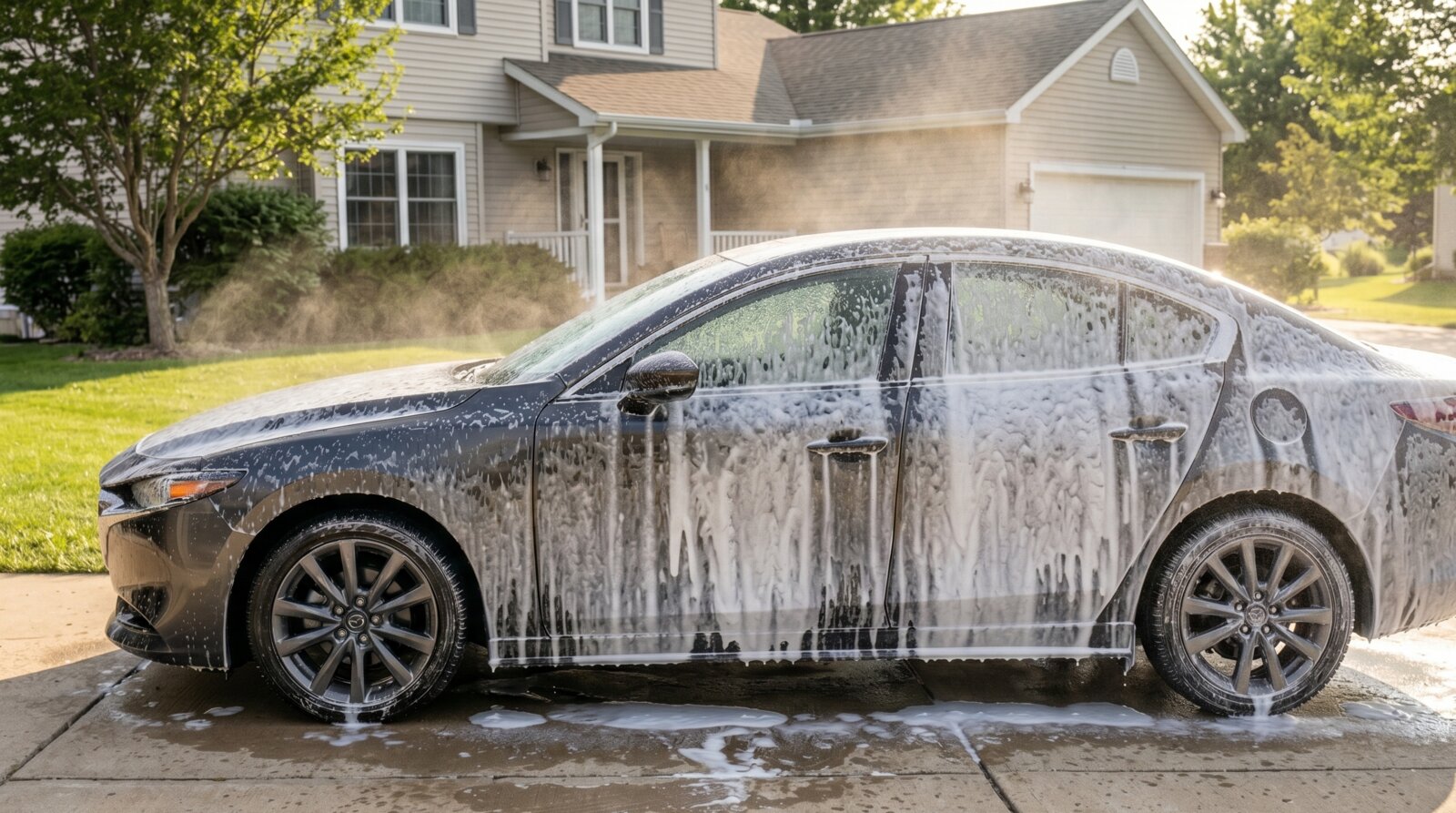
When you wash a coated car, the dirt isn't gripping the surface. The slick layer doesn't give it anything to hold onto. A rinse pass alone takes off a remarkable amount before you ever touch a mitt. The two-bucket wash that took an hour on uncoated paint takes 25 minutes on coated paint, and the result is cleaner — fewer micro-swirls, less dragging dirt across the panel.
This is the single most-cited observation across our review base. It's not because the soap is faster. It's because the surface stopped fighting back.
7. The application is one walk-around the car
The thing that kept people on wax (even people who knew the protection numbers were better elsewhere) was application anxiety. Pro-shop ceramic kits have a real failure mode: high spots that flash past their working window before you can buff them, streaks that harden into the film, panels that need machine-polished back before they can be re-coated. Hours of careful work and days of cure time, with a real “did I do this right?” gut-check at every step.
A graphene spray works differently. The whole job is one walk-around the car. Spray a panel, spread it with the towel, move on. Streak? Spread it again. Missed a spot? Re-spray. There is no failure mode that locks in before you can fix it.
IMAGE: real customer photo — current red-label bottle, yellow C6 Corvette (source: 260414_Shinemd All Shopify Content / WhatsApp_Image_2024-11-14_at_04.29.59_38cbf67e.jpg)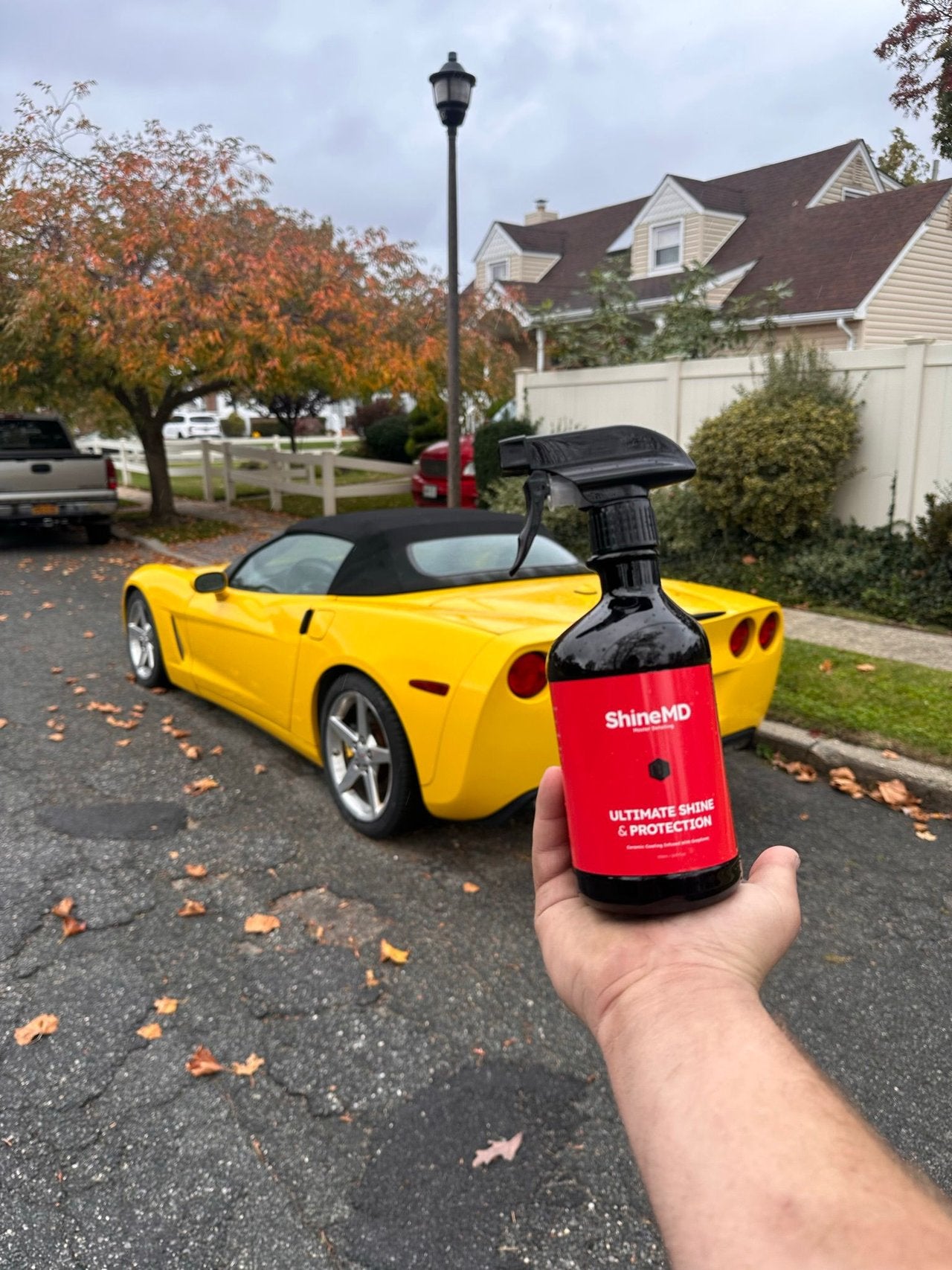
That's the entire reason the spray-on category exists in the first place. A coating you never apply doesn't protect anything.
Switch from wax. One Saturday.
Graphene + SiO₂ formula. 6–12 months of protection.
60-day money-back guarantee.
Fast shipping · No subscription required · Easy returns
- Fast Shipping
- 60-Day Moneyback
- Formulated in USA
- 900+ Reviews
- Graphene Featured In NYT · Forbes · WaPo