
Your First Application What to Expect
Wash. Spray. Spread. Walk around the car. The whole job is one walk-around — and there's no “you ruined the paint” moment hiding in the next panel.

Most people don't hesitate over ceramic coatings because they're skeptical of the science. They've already done the homework.
They hesitate because they're worried about messing it up.
That's the real objection. The bottle is on the doormat. The microfiber is in the kitchen drawer. And somewhere between unboxing it and walking outside, the same question keeps surfacing: what if I do this wrong and end up staring at a streaky panel I can't undo?
Fair question. Here's the answer.
Protection only works if it's easy enough to put on. That's the design constraint of every product like this: the whole category falls apart if the application is harder than the result is good. ShineMD is engineered around it. The whole job is one walk-around the car. Spray, spread, move on. There's no “you ruined the paint” moment hiding in the next panel.
The rest of this guide walks through what each step looks like, what the paint feels like after, and why this category is forgiving in a way premium installs aren't.
What you'll need
Before you start, here's the full kit:
- One bottle of ShineMD.
- One clean microfiber towel. Soft, plush, ideally 350+ GSM. Not a paper towel. Not a glass-cleaning towel.
- 30–45 minutes for a sedan. Add 10–15 for an SUV or truck.
- A washed, dry car parked out of direct sun. Shade or a garage works fine.
That's the whole list. No buckets of polish. No applicator pads. No tools you don't already have or can buy for $4 at any auto store.
The five steps
The whole job is one walk-around. Here's what happens at each panel.
Step 1 — Wash
Standard wash. Two-bucket, touchless, foam-cannon-and-hose, whatever you normally do. The point is to get road film, dust, and brake dust off the clear coat so the coating bonds directly to your paint. Skip the wash and you're sealing in whatever was stuck to the surface.
Dry the car fully before moving on. Damp panels won't hold the coating evenly.
IMAGE: real photo, Coy-supplied ad creative — bottle staged on the driveway, car mid-wash behind (source: Media Portal / 01 Ad Creative / 1. ShineMD Spray / Copy of IMG_8602.JPG)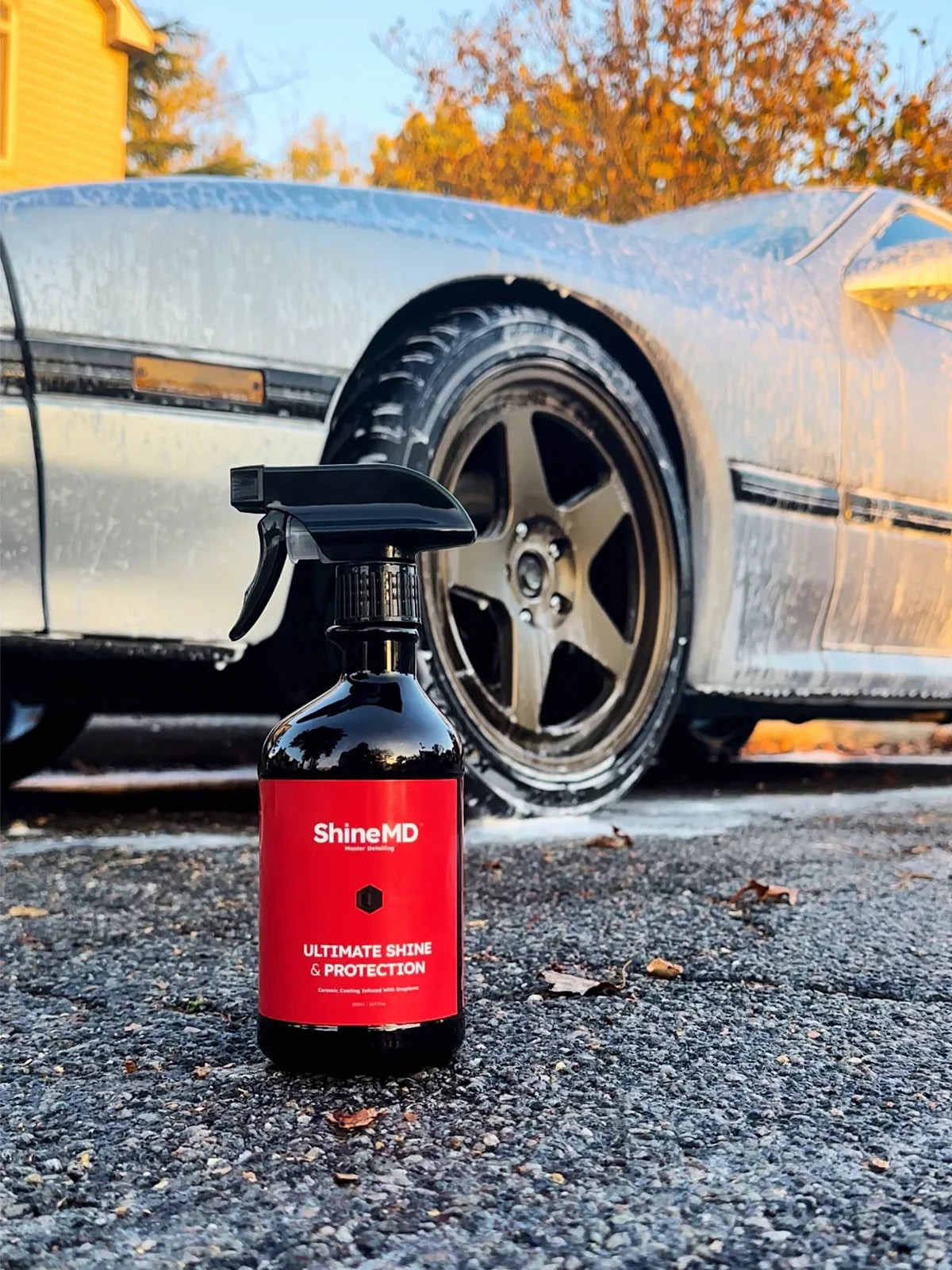
Step 2 — Decontaminate, if the paint needs it
Run your fingertips across a panel after the wash. If it feels gritty (like fine sandpaper), there's bonded contamination on the clear coat that a normal wash won't lift: iron fallout, tree sap residue, industrial dust. That's what a clay bar removes. Five minutes per panel, no special skill required.
If the paint feels glassy under your fingertips, you can skip this step. Newer cars or recently-decontaminated cars usually pass the test. Older daily drivers usually don't. And on those, the coating bonds much better to a clean surface than to a surface with iron particles sitting under it.
When in doubt, clay. Five minutes of prep buys you months of cleaner protection.
Step 3 — Spray
One panel at a time. Two or three light spritzes covers a section the size of half a hood. A little goes a long way. Buyers consistently mention how much smaller a dose they end up using than they expected.
Don't soak the panel. The coating spreads from the spray, not from a puddle.
Step 4 — Spread
Take the microfiber. Work the spray edge-to-edge with light, overlapping passes. Then flip to a dry side of the towel and buff the panel once more for the wet-look gloss.
Roughly two minutes per panel. There's a working window — the product sets as it flashes — but it's a generous one, and if you streak it, you spread it again within that window. You don't have to be fast. You just have to keep moving.
Step 5 — Walk around the car
Hood. Roof. Trunk. Door panels. Side mirrors and the painted parts of the bumpers. Spray, spread, move on.
When you've walked around the car, you're done. The whole job — one walk-around the car. That's the entire process.
What you'll feel afterward
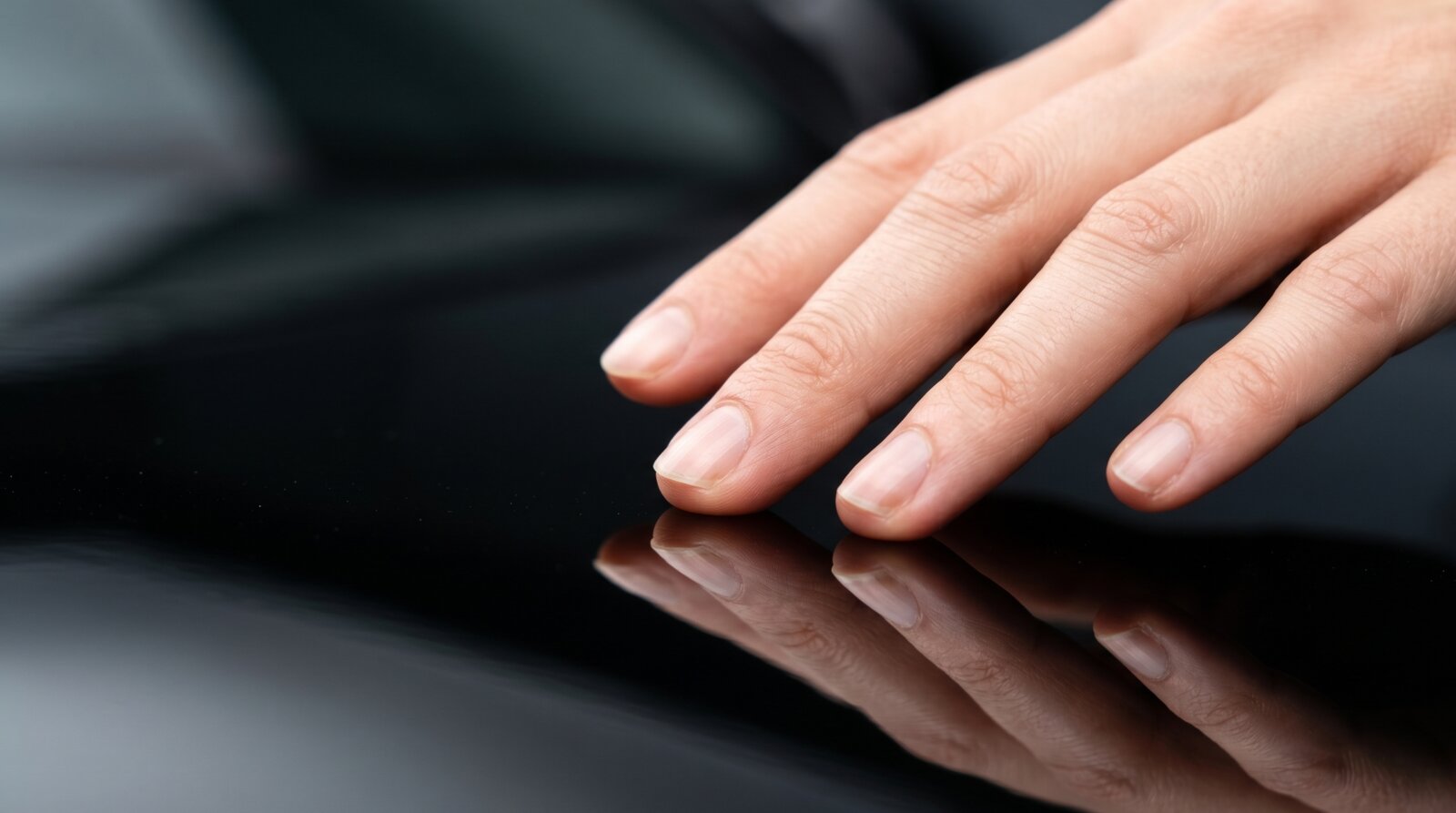
Drag your fingertips across a panel you just coated.
The surface is profoundly smoother. Not “kinda nice” smoother — the kind of smoothness that makes you do it a second time to confirm. Your finger glides instead of catching. That's the coating doing real surface chemistry: graphene and SiO₂ bonded into a thin protective layer over your clear coat.
We push the same point harder in a friction test on video. Set a full bottle on a flat coated panel. Let go. The bottle slides off the surface like an air hockey puck.
That's not a metaphor. The cured silica surface has a lower coefficient of friction than uncoated clear coat — measurably less drag against the bottle, your fingertips, dust, and water. It's also the strongest in-the-moment proof you'll get that the coating took: if your fingertips feel the difference, you applied it correctly.
The next time it rains — or the next time you wash the car — you'll see the second proof. Water beads on contact and rolls off in sheets. That's the hydrophobic surface doing its job. Some owners stand in the driveway with a hose just to watch it the first time.
Forgiveness is built in
Here's what makes the spray-on category forgiving in a way solvent permanent ceramic installs are not.
If you miss a spot, you spray again. If you streak a section, you spread it again. If you over-applied on the hood, the next light buff evens it out. There's no mistake that locks in before you can fix it — no “you ruined the paint” moment that costs you a polish-and-correct visit at a body shop.
The reason: this category is designed for re-application every 6–12 months, depending on climate and wash frequency. The long-arc plan is iteration, not perfection on the first pass. Your first walk-around can be exactly that — a first walk-around. Most owners report the second one feels twice as confident.
What you'll notice over the next six months
Wash day, week one. Water sheets and beads. Soap rinses faster. The car looks cleaner than it usually does after a wash because micro-contaminants don't grip the surface the way they used to. This is where the time-savings reports start: owners notice the wash is faster before they notice the gloss.
Month one. The wet-look gloss settles in. Direct sunlight on the hood makes the paint look like it was painted yesterday.
Month three to six. Beading is still there. UV resistance is doing quiet work — slowing oxidation, keeping the gloss from going chalky. You'll notice this less because it's the absence of damage, not the presence of a feature.
When you're done
Wipe down the bottle. Toss the microfiber in the wash bin. Stand back from the car for a second.
The next thing — the only thing — is the next wash day. That's where you'll feel the difference.
Ready for your first walk-around?
One bottle. One microfiber. 30–45 minutes.
60-day money-back guarantee. No questions asked.
Formulated in USA · Fast shipping · No subscription required
- Fast Shipping
- 60-Day Moneyback
- Formulated in USA
- 900+ Reviews
- Graphene Featured In NYT · Forbes · WaPo