
What's Actually In ShineMD
Most paint-protection products tell you what their formula does and never quite tell you what's in it. Here's the ShineMD formula in plain English — two named actives, plus the supporting agents that get them to bond.

Most paint-protection products are vague about their ingredients on purpose.
The marketing wants the language to sound proprietary: “advanced polymer technology,” “exclusive nanoparticle blend,” “9H ceramic complex.” The chemistry is usually less mysterious than the copy suggests, but the vagueness gives the brand room to charge a premium and keeps competitors guessing.
We don't think that serves you. If you're going to put something on the only finish your car has, you should know what's in it and why each piece is there.
ShineMD has two named actives (graphene and SiO₂) and a small set of supporting agents that get them to bond evenly to your clear coat and stay there. None of it is a secret.
The whole formula, in plain language
Graphene for strength.
SiO₂ for hardness.
A flow agent so it spreads evenly.
A polymer binder so it bonds and stays.
Two named. Two by role. That's the full picture.
If you stop reading right here, you have the entire formula. The rest of this article is just the why behind each line.
Ingredient 1 — Graphene, for strength
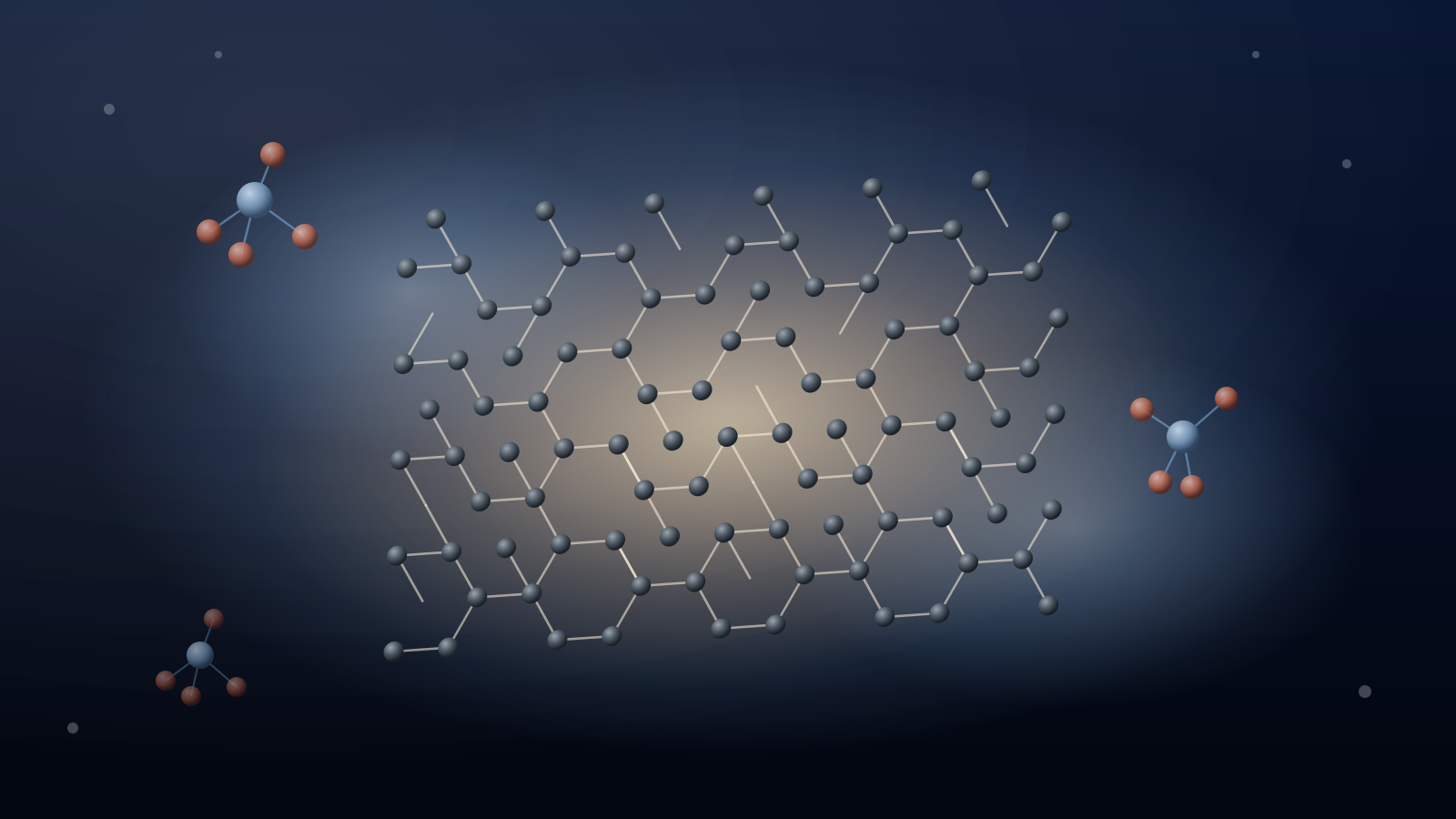
Graphene is a single layer of carbon atoms in a hexagonal pattern. Picture chicken wire, one atom thick.
At the atomic plane, it has been measured at roughly 200× the tensile strength of steel — the strongest material ever recorded. A spray coating doesn't deliver that number on your hood (no graphene-composite product does), but even a small fraction of that strength, dispersed inside a silica matrix, is what gives a graphene-ceramic its toughness advantage over plain SiO₂. The science article digs into exactly how that translates from the lattice to a coating. It's a Nobel Prize winning material; the 2010 Physics prize went to Andre Geim and Konstantin Novoselov for isolating it.
In a coating, what graphene contributes is toughness — the ability to resist cracking. When a microscopic fracture starts somewhere in the coating layer (from a stone chip, a stiff brush, thermal expansion in summer heat), a graphene flake in its path forces the crack to detour or stop entirely. Cracks that detour use up energy. They run shorter. Many of them never propagate.
Graphene by itself isn't a coating, though. It's a flat sheet of carbon. It needs a host material that hardens around it.
That's where SiO₂ comes in.
Ingredient 2 — SiO₂, for hardness
SiO₂ (silicon dioxide) is the chemistry behind every “ceramic” coating on the market. It's been the workhorse of pro-shop paint protection for over a decade for one reason: it bonds beautifully to clear coat and cures into a hard, glassy layer that resists being scratched, etched, or worn down.
Hard, though, isn't the same as tough. A pane of glass is hard. It also shatters when something flexes it. Pure ceramic coatings can be brittle — fine under light use, less forgiving when a real-world impact tries to crack them.
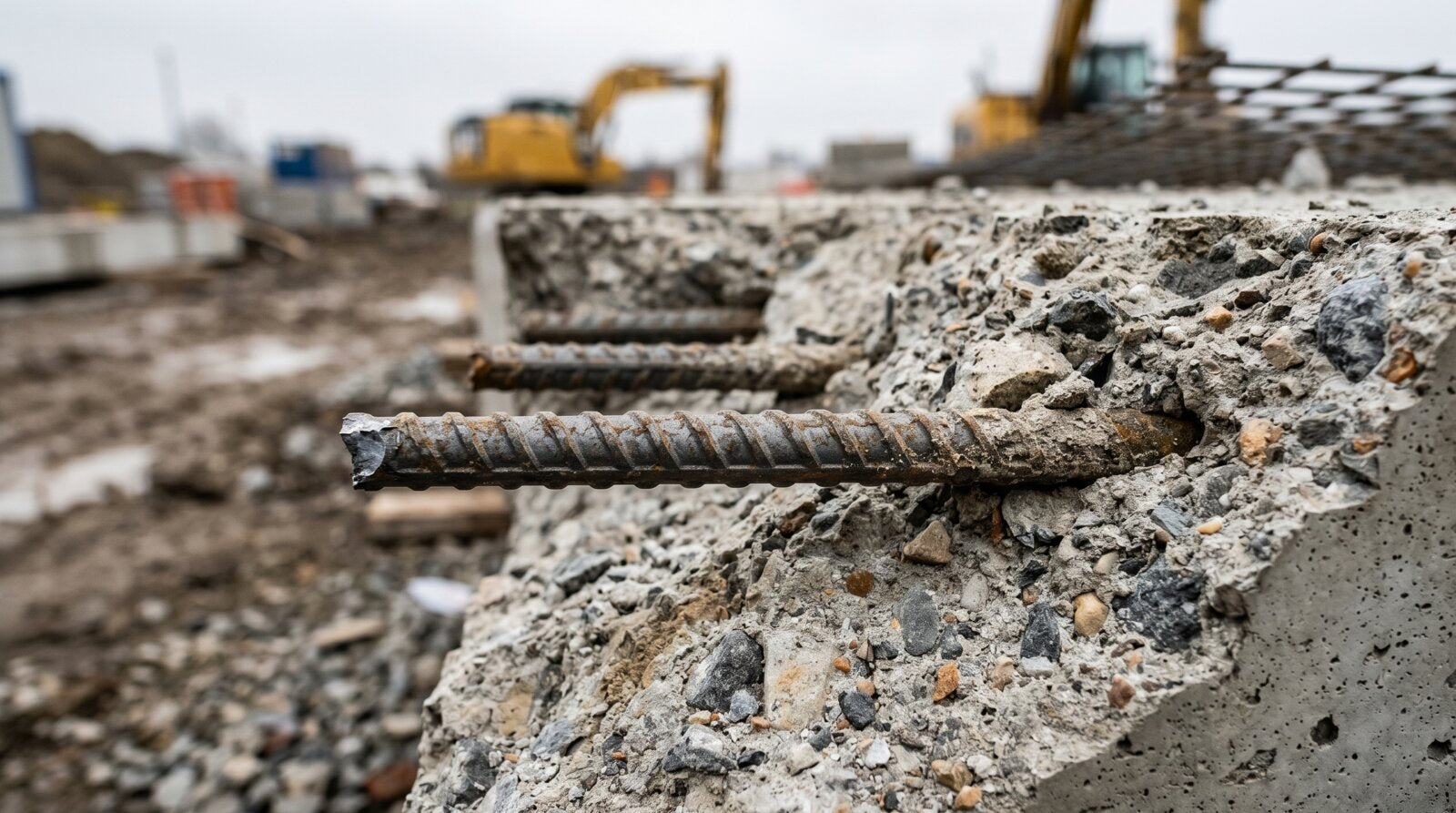
The mental model is rebar in concrete. Concrete handles compression — being pushed on. Steel rebar handles tension — being pulled apart. Neither is impressive on its own. Together they hold up bridges.
SiO₂ is the concrete: hard, rigid, good at resisting being pressed into. Graphene is the rebar: extraordinarily strong in tension, with the unusual ability to stop microscopic cracks before they spread. Lab studies on graphene-reinforced silica composites consistently measure meaningful fracture-toughness gains over plain silica. That's the rebar working.
This is why “graphene + SiO₂” isn't a marketing combo. It's the chemistry. SiO₂ for hardness. Graphene for toughness. Together, a coating that resists both being scratched and being cracked.
Ingredient 3 — A flow agent, to spread it evenly
A bottle of pure graphene + SiO₂ would be unusable. The active chemistry would clump, dry too fast, and leave streaks the moment it hit the paint. You'd have a great formula and a terrible product.
The flow agent is what turns that chemistry into something a person can actually apply.
Its job is mechanical, not chemical. It carries the graphene and SiO₂ across the panel in a thin, even layer. It buys you working time — long enough to spread the product before it starts to set, but not so long that it never cures. It evaporates as the coating bonds, so it leaves nothing behind.
A good flow agent is the difference between a graphene spray you can use in your driveway in 20 minutes and a pro-shop coating that requires a controlled environment and an hour of cure time per panel.
We don't list the specific compound publicly because it's the one piece of the formula where competitors actively reverse-engineer. The category, though, is no secret — automotive coating chemistry has used variants of this approach for decades. What matters for you is what it lets the product do: lay flat, spread evenly, give you forgiveness.
Ingredient 4 — A polymer binder, to lock it to your paint
The polymer binder is the part nobody talks about and everybody depends on.
Once the flow agent has carried the graphene + SiO₂ to the surface and started to evaporate, something has to chemically anchor the protection layer to the clear coat underneath. That's the binder's job.
Clear coat is itself a polymer — a long-chain molecule. The binder is designed to form covalent bonds with that polymer surface as it cures. “Covalent” means electrons are actually being shared between molecules, not just attracting each other. That's the difference between something that sticks because it's slightly sticky (like wax) and something that's chemically grafted onto the surface (like a graphene-ceramic coating).
This is why a properly bonded coating doesn't wash off. The graphene and SiO₂ aren't loose on your paint. They're held there by a binder that has chemically attached to the clear-coat surface — covalently bonded, not just stuck.
When people ask “how long does it last?” what they're really asking is “how long until the binder breaks down?” The honest answer is 6–12 months of protection, depending on climate and wash frequency. A daily driver in harsh sun trends toward the bottom of that range. A garage-kept weekend car trends toward the top. Realistic middle is 8–10 months for most owners. The proof that the binder is still doing its job is the beading — water still pearling up and rolling off the panel.
What's not in the bottle
Worth saying out loud. ShineMD doesn't include:
A tint or dye to make first-week shine look more dramatic than the coating is actually doing. Some products carry trace coloring that fades over weeks, and the impression of protection fades with it, leaving you guessing what was real. We don't do that. The shine at week one is the shine at month six.
Filler oils that add slickness without adding protection. Some sprays use silicone oils to make a panel feel slippery in the showroom. Feels great, lasts a week, and isn't doing structural protection.
Anything with permanence claims. We don't say “permanent,” “lifetime,” or “10-year.” Coatings degrade. The honest range is 6–12 months. Anyone telling you longer is selling something else.
Two named actives. Two supporting agents by role. All four with a job to do. No magic.
“Will I be able to apply this?”
Yes. That's the whole point of how the formula is engineered.
The flow agent and binder do the heavy lifting on the application side, which is why the whole job is one walk-around the car. Spray, spread, move on. There's no install mistake that locks in before you can fix it. The chemistry inside the bottle is the same caliber that pro shops use; the chemistry around it is what makes it possible to apply yourself, in a driveway, in under an hour.
If application is the thing keeping you on wax, the first-application walkthrough is the right next read.
Try ShineMD on your car.
Graphene + SiO₂ formula, developed and tested in the USA.
60-day money-back guarantee.
Fast shipping · No subscription required · Easy returns
- Fast Shipping
- 60-Day Moneyback
- Formulated in USA
- 900+ Reviews
- Graphene Featured In NYT · Forbes · WaPo