
Real Results From Real Drivers
What owners actually report at week one, month three, and month six. The pattern that keeps showing up across hundreds of reviews — and the one phrase that comes up more than any other.

The most useful product reviews aren't the ones with the most stars. They're the ones that read like a friend describing what changed.
What follows is a synthesis of that. Not a single review held up as proof. The pattern that shows up across more than 900 ShineMD reviews: the language owners actually use, the timeline they actually report, and the moment most of them say should have done this sooner.
It starts with one phrase.
The line we hear most
When buyers describe the after, the phrase that comes up over and over is some version of:
“Wash days are so much faster now.”
— a pattern across 900+ ShineMD reviews
Not “my car looks amazing.” Not “best product I've ever used.” That language exists in the review base too, but it's not the dominant theme. The dominant theme is about time.
Why time? Because once a graphene coating is on, the wash is genuinely a different job. Soap rinses faster. Dirt that would normally drag across the clear coat — and grind in micro-swirls every time — instead glides off the slicker surface. There's less scrubbing. Less rebuffing. The bucket-and-towel ritual that used to take an hour takes thirty minutes, and the car looks better at the end of it.
That's the pattern. The protection isn't the headline for most owners. The time savings are.
Everything else in this article is built on top of that one finding.
Week one — the visceral first wash
The first proof point most owners report isn't gloss. It's a moment that happens during the first wash after application.
Water hits the panel and beads — not in the loose, half-flat way it does on a wax-coated car after a couple of months, but in tight, high-contact-angle pearls that roll off in sheets when you tilt the panel. I can't believe how slippery it feels and water just rolls off are direct echoes from the review base.
Two visual proof points usually stack on top of that:
The fingertip test. Drag your fingertips across a freshly coated panel. The surface feels profoundly slicker than uncoated paint — almost like the friction has been removed at the molecular level. (It has. That's what graphene + SiO₂ does to a clear coat.)
The bottle slide. This is the friction test ShineMD demonstrates on video. Set a full bottle on a flat coated panel. Let go. The bottle slides off the surface like an air hockey puck. It's a visceral demonstration of how much friction the coating actually removes.
What owners do with these proof points is interesting. About a third of reviews mention testing the beading or the slipperiness on day one, not because the manual told them to, but because they wanted to confirm the coating took. That's the moment the purchase becomes real.
Three buyer-story shapes that keep showing up
Across the review base, three story shapes recur often enough that they function almost as templates. The descriptions below are aggregate patterns, not direct quotes from any single owner. They describe what people in each group tend to report.
The skeptic-who-tried-it
Owners in this group come in expecting to be disappointed. They've usually paid a detailer $400–$600 for a ceramic install in the past and don't believe a $40 bottle can do the same work. They report being surprised by how short the application actually is (a sedan runs 30–45 minutes panel to panel), and the day-one water beading is where the assumption starts to break. The hardest part, by their own account, isn't the labor. It's trusting that a spray-on at this price can deliver pro-tier hydrophobic behavior. The first wash after application is the moment that resolves.
The wax-veteran-who-switched
This is the most common shape in the review base. Long-time carnauba users (often a decade or more into the ritual) switch and report two distinct findings. First, durability they can see: still beading at month four when their previous wax would have been gone by month two. Second, time savings they can feel: roughly half the wash time, every wash. The shift comes with a recurring sentiment that we read in the reviews as some version of should have done this sooner. The wax ritual gets replaced with a faster, more durable answer, and the regret-of-delay note shows up reliably.
The first-time-coater
The third shape clusters around new entrants to the protection category — owners who have never applied any kind of ceramic before. The arc is consistent across these reviews: anxiety about a wrong install going in, surprise at how forgiving the application turns out to be, durability proof in the first month, and a quiet conversion. The descriptor that comes up most often in this group is some variant of easier than I expected — particularly around the fact that streaks can be re-spread and missed spots re-sprayed without consequence.
What you'll see at month three
The first wash proves the coating took. Month three is where owners start to trust it. Across the review base, three observations come up consistently:
Beading is still there. Water still pearls and rolls off in sheets. On most cars, the bead pattern at month three looks effectively identical to day one — some flattening on horizontal surfaces that catch the most sun and rain, but the working hydrophobic behavior is intact.
Less rebuffing between washes. The owners who used to chase water spots and dust streaks every couple of weeks report doing that less. Contaminants don't grip the way they used to, so the car holds its appearance between washes longer.
The wash is still fast. Whatever the dominant review theme set up at week one (wash days are so much faster now), it doesn't fade by month three. The time savings are durable in the way the protection is.
What owners specifically don't report at month three: a sudden cliff in performance. A wax-coated car at month three is essentially uncoated. A graphene-coated car at month three is, by every owner-reported metric, still working.
What you'll see at month six and beyond
Six months is where the conversation gets honest.
ShineMD's durability claim is 6–12 months of protection, depending on climate and wash frequency. Six months is the floor of that range: the point where a daily driver in a harsh climate, run through automated washes, would start to see the bead pattern flatten meaningfully on horizontal surfaces. A garage-kept weekend car in a mild climate, hand-washed, is typically still beading well past month six and trending toward the top of the durability range.
That's the climate/wash-frequency variable doing real work. It's why the durability claim is a range, not a number.
What the review base reports at six months:
For most owners, the coating is still working. Beading is reduced from day-one levels but still present on vertical surfaces and panels that don't catch direct sun all day. The wash is still faster than the wax routine that came before. The gloss has settled into a deep, even finish — owners often describe it as looking better at month six than at month two, because the wet-look settles in over the first couple of weeks rather than peaking on day one.
For high-mileage drivers in harsh conditions, the bead pattern flattens earlier. That's the bottom of the 6–12 month range showing up. The honest move at that point is a re-application — one Saturday morning, one walk-around the car, and the coating is reset.
The protection isn't gone by surprise. The beading tells you when. As long as water still pearls off the panel, the coating is still on the paint. When it flattens, it's time to refresh.
That's the rhythm of the category. Not permanent. Not annual. Repeat-friendly enough that most owners say I should have done this sooner and end up running a 6–12 month cycle that costs less in time and money than what they were doing before.
Four more owners, four more pieces of paint
The before/after archive is the simplest version of this argument. The RX-8 above the headline is one; here are four more.
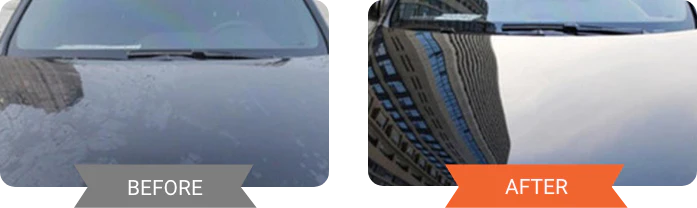
The dark sedan. Garage-kept weekend car. Before: minor swirling visible in side light. After: the swirls are masked by the depth of the coating, and side light reads as gloss instead of micro-scratching.
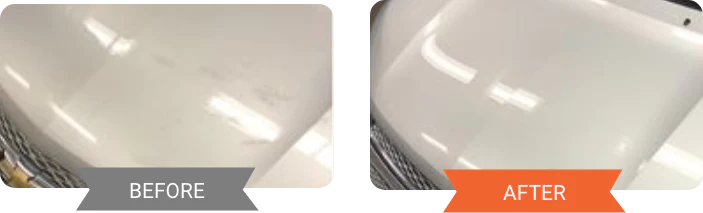
The white panel. Daily commuter. Before: water-spot halos from hard water dried in flat puddles. After: the same hard-water exposure beads off before it dries — no halos, no chemical removers needed.
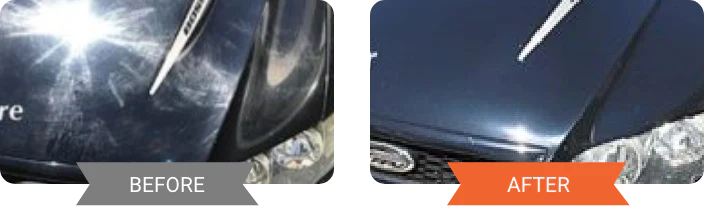
The black sport coupe. The most dramatic of the five. Before: heavy swirl marks across the hood from years of automated washes. After: a panel that finally looks the way the factory delivered it, with the swirling masked by a uniform gloss layer.
The black Mercedes. Before: dust adhering to the panel, faint orange-peel texture catching light. After: dust beads off in the first rinse, the texture reads as flat reflective gloss instead of fragmented light.
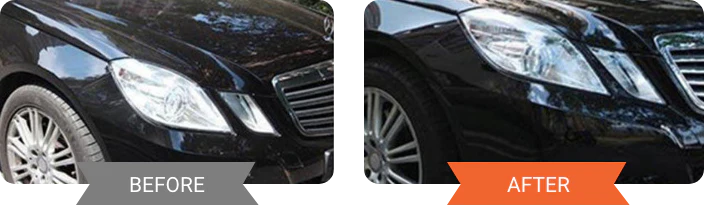
Four cars, four clear coats, four owner-reported outcomes — five if you count the RX-8 at the top of the page. The pattern that holds across all of them: a hydrophobic surface that water can't grip, paint that holds gloss longer between washes, and a wash routine that takes meaningfully less time.
Same pattern across 900+ reviews.
The version of this article worth trusting
The version of this article that's worth trusting isn't the one you read.
It's the version where you put the bottle on your own paint, watch the water bead off the hood the next time it rains, and say some version of the line that started this article — wash days are so much faster now — out loud, to nobody in particular, the next time you wash the car.
That's the one.
Run the test on your own car.
One bottle. One walk-around. The next rain tells you the rest.
60-day money-back guarantee.
Formulated in USA · Fast shipping · No subscription required
- Fast Shipping
- 60-Day Moneyback
- Formulated in USA
- 900+ Reviews
- Graphene Featured In NYT · Forbes · WaPo